cnfanssheet.com
Rick Owens Missing Specs: Stop-Buying Checklist
Introduction When browsing [Rick Owens](https://fashion-reps.net/brand/rick-owens) products on [fashionreps](https://fashion-reps.net/), pages may only show the product name, color, partial material description, reference price, or size range, but not necessarily the full upper material, lining, sole thickness, actual measurements, stock status, and return conditions. At this point, the most important action is not to fill in missing information based on images, but to judge which missing fields
Editor score 4.2 / 5
Introduction
When browsing Rick Owens products on fashionreps, pages may only show the product name, color, partial material description, reference price, or size range, but not necessarily the full upper material, lining, sole thickness, actual measurements, stock status, and return conditions. At this point, the most important action is not to fill in missing information based on images, but to judge which missing fields are already enough to affect the purchase decision.
This article addresses only one question: when product page specs are incomplete, how to build an actionable stop-buying checklist. After reading, you should be able to separately record page facts, what is visible from images, and what still needs confirmation, and then decide whether to continue verification, save for observation, or hold off on ordering. This article does not apply to products for which complete size charts, measured data, and after-sales conditions are already available.

Figure: A checklist illustration for organizing visible and missing fields on product pages.
Defining the Impact of Missing Specs on Purchase Decisions
Missing specs do not necessarily mean the product has problems, but they reduce the verifiability of the purchase decision. For footwear, the foot length corresponding to a size, last width, collar height, upper and lining materials, sole structure, closure type, and available colors can all affect fit, durability, appearance, and return risk.
You can first divide information into three categories:
- Confirmed: content explicitly written on the page, or accurately readable from page fields.
- Observable: visual elements visible in images such as color, silhouette, zipper, or laces, but cannot be used to infer hidden structure or actual material.
- Unconfirmed: content not stated on the page, or where text and images are insufficient to support judgment.
Whenever a missing field would change size selection, material acceptance, total cost, or after-sales decision, hold off on ordering. 🛑
Recording Visible Fields of Rick Owens Products from fashionreps Pages
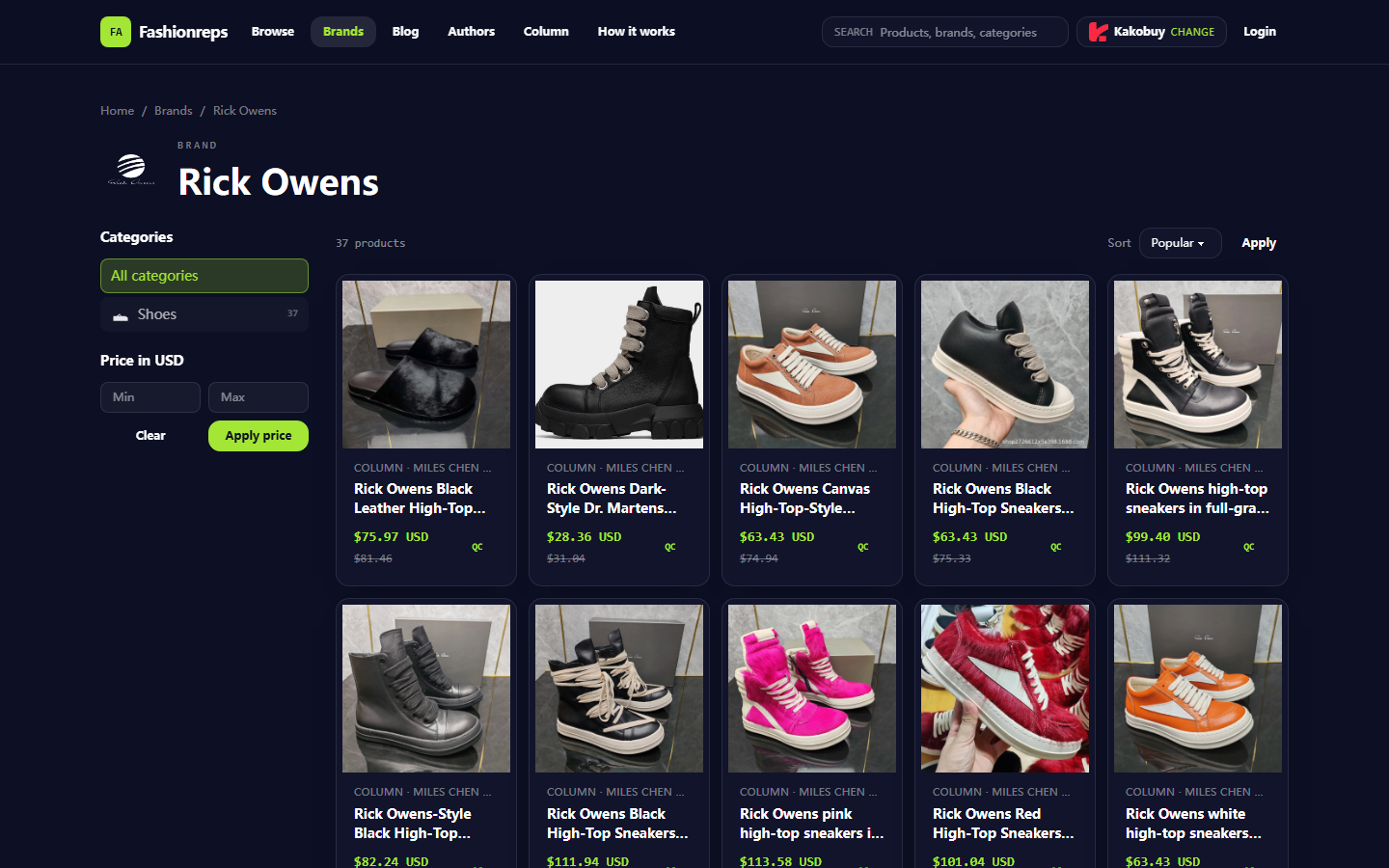
Verification date: October 21, 2026. The currently provided Rick Owens brand page shows 37 products, with sample fields including product name, category, reference price, and partial descriptions. The sample pages show descriptions such as high-top shoes, canvas shoes, leather shoes, suede shoes, etc., and some products specify size range, side zipper, sole structure, or material name.
This information can only serve as page records and cannot automatically be upgraded to complete specs. For example, words like "full-grain leather," "canvas," or "sheepskin" in the name only indicate that the page describes it that way, and does not mean that the material source, thickness, lining composition, or physical consistency has been verified. The presence of a reference price on the page also does not mean that the price includes service fees, international shipping, taxes, or return costs.
It is recommended to save page evidence in the following order:
- Record the full product name, page category, and reference price.
- Save the color, material, closure, sole description, and size range shown on the page.
- Record whether the page states stock, shipping time, return conditions, and size recommendations.
- Save the main product image and its position on the page, but do not write visual impressions from the image as measured conclusions.
- Mark the status of each field: confirmed, observable from image, or unconfirmed.
If the page only gives a broad name without corresponding fields or measurement data, it should be kept as "unconfirmed," and not filled in with similar styles, brand common sense, or information from other sellers. 🔎
Building a Missing Items Table by Size, Color, Material Description, and Style Information
| Check Category | Information the page may already provide | Key fields still needing confirmation | Action when missing |
|---|---|---|---|
| Size | Partial size range or generic size labels | Insole length, foot width recommendations, size conversion, last width | Pause size selection and ask the seller for measurement methods and corresponding data |
| Color | Color words in product name, main image appearance | Specific color code, batch color differences, accessory colors | Do not treat image colors as accurate color codes; record as pending confirmation |
| Material | Descriptions of leather, canvas, suede, etc. in page text | What materials are used for upper, lining, insole, and sole separately | Request a breakdown by part; if unconfirmed, do not order based on material preference |
| Style structure | Visible info such as high-top, side zipper, laces, or platform sole | Sole thickness, heel height, zipper function, internal support | If structure affects wear or size, include in stop-buying conditions |
| Product status | Product name and reference price | Stock, production batch, actually available sizes, defect standards | If stock cannot be confirmed, do not treat page display as purchasable stock |
| After-sales conditions | Basic instructions possibly provided on the page | Whether returns are allowed after trying on, return period, cost responsibility, and evidence requirements | If rules are unclear, verify with the seller or chosen shopping agent first |
In the table, "provided" only means that the page contains such text, not that the content has been verified through independent evidence. 🧾
Comparing Product Images with Page Text Without Guessing Unknown Specs
Images are suitable for checking whether the appearance is roughly consistent with the text, for example, when the page says side zipper, whether the image shows the corresponding position; when the page says high-top silhouette, whether the image indeed shows a high-top structure. Images are not suitable for proving the actual material of the upper, lining softness, sole weight, comfort, durability, or whether the size is accurate.
When the following situations occur, the images and text should be marked as inconsistent or insufficient evidence:
- The page states a specific material, but the image resolution is insufficient to observe the surface structure.
- The product name mentions a certain closure type, but the main image does not show the relevant part.
- The page gives a size range, but there is no foot length, insole length, or size conversion standard.
- Different images of the same product show differences in color, sole, or accessories.
- The page description uses words like "style" or similar style expressions, but does not specify the actual material and structure.
Do not replace specs with "looks like," "should be," or "usually has." For purchase decisions, these words only indicate speculation and cannot serve as a basis for ordering.
Determining Which Information Can Be Supplemented Through Page or Official Channels
Prioritize supplementing fields that will directly change the purchase outcome, rather than first collecting all details. You can ask in the following order:
- What size is needed? Please provide foot length, foot width, measurement unit, insole length, or corresponding size chart, and state the measurement error range.
- What is the material? Please specify the upper, lining, insole, and sole separately, rather than giving only a vague material term.
- Does the structure match the images? Please confirm whether the side zipper, laces, sole thickness, collar, and accessories belong to the current batch.
- Is the target size and color currently available? Please confirm whether the page display matches the actual purchasable stock.
- If it doesn't fit, what evidence is needed for a return, within what period, and who bears the cost?
You can submit these questions through the consultation entry on the product page, the seller's communication channel, or the order inquiry process of your chosen shopping agent. If the page has no clear official statement, do not treat third-party reviews, other product pages, or search snippets as official specs for the product.
When submitting an inquiry, include the product name, page screenshot, target color, target size, and specific missing fields. Do not send unnecessary payment information, complete order details, or personal documents. 🔐
Distinguishing Page Facts, Editorial Judgments, and Unconfirmable Content
When recording, it is recommended to use three columns instead of mixing everything into one paragraph:
- Page facts: for example, the page shows 37 products, a certain name contains a color word, a certain product text mentions material or side zipper.
- Editorial judgments: for example, missing size data increases the risk of choosing wrong size; incomplete material fields affect whether to accept the product.
- Unconfirmable: for example, actual insole length, lining material, current stock, batch differences, and after-sales execution results.
Editorial judgments are not product facts. This article has not conducted purchase, receipt, wearing, or physical measurement, nor has it treated page images as physical inspection results. If automated content is to be published, the verification date, page screenshots, and field records should be preserved to avoid making readers think there are real-person trial conclusions.
Forming the List of Screenshots and Links to Attach When Submitting an Inquiry
The system will process page links after saving, so when preparing content, you only need to organize evidence and not manually add links in the article. When submitting an inquiry or internal review, it is recommended to prepare:
- Product name and page screenshot.
- Page text showing reference price, color, size, and material.
- Screenshots of image areas corresponding to missing fields.
- Specific questions for the seller, each question corresponding to only one field.
- Verification date, and whether the page shows stock and after-sales instructions.
- If an inquiry has already been made, save the reply time and original response, not just your own summary.
Screenshots should cover order numbers, phone numbers, addresses, payment information, and other personal data. Do not crop out product fields that affect judgment, nor modify images to hide flaws or create clearer spec evidence.
Deciding to Continue Verification, Save, or Hold Off Based on Evidence Completeness
You can use three levels to decide the next step:
- Continue verification: size, material, and key structures still have gaps, but the seller or shopping agent can provide verifiable answers or measurement records.
- Save for observation: product appearance meets needs, but stock, batch, price, or after-sales information is fluctuating, and there is not enough evidence to order immediately.
- Hold off ordering: missing size data, material descriptions, actual stock, or return conditions that would directly change the purchase decision, and clear supplementation cannot be obtained.
The stop-buying checklist should include at least any one of the following: inability to confirm whether the target size is available; inability to obtain basic data such as foot length or insole length; page material description is too vague and the seller refuses to provide a breakdown by part; images and text conflict on key structures; page shows a price but actual purchasable status cannot be confirmed; after-sales conditions cannot be clearly answered before payment.
The value of this checklist is not to prove that a certain Rick Owens product is definitely worth buying, but to expose uncertainty. When information is complete, you can continue comparing; if information remains missing, you should preserve your funds and after-sales options.
Keep reading on this site
Gucci Black Tee Candidate List: fashion-reps vs Sheets 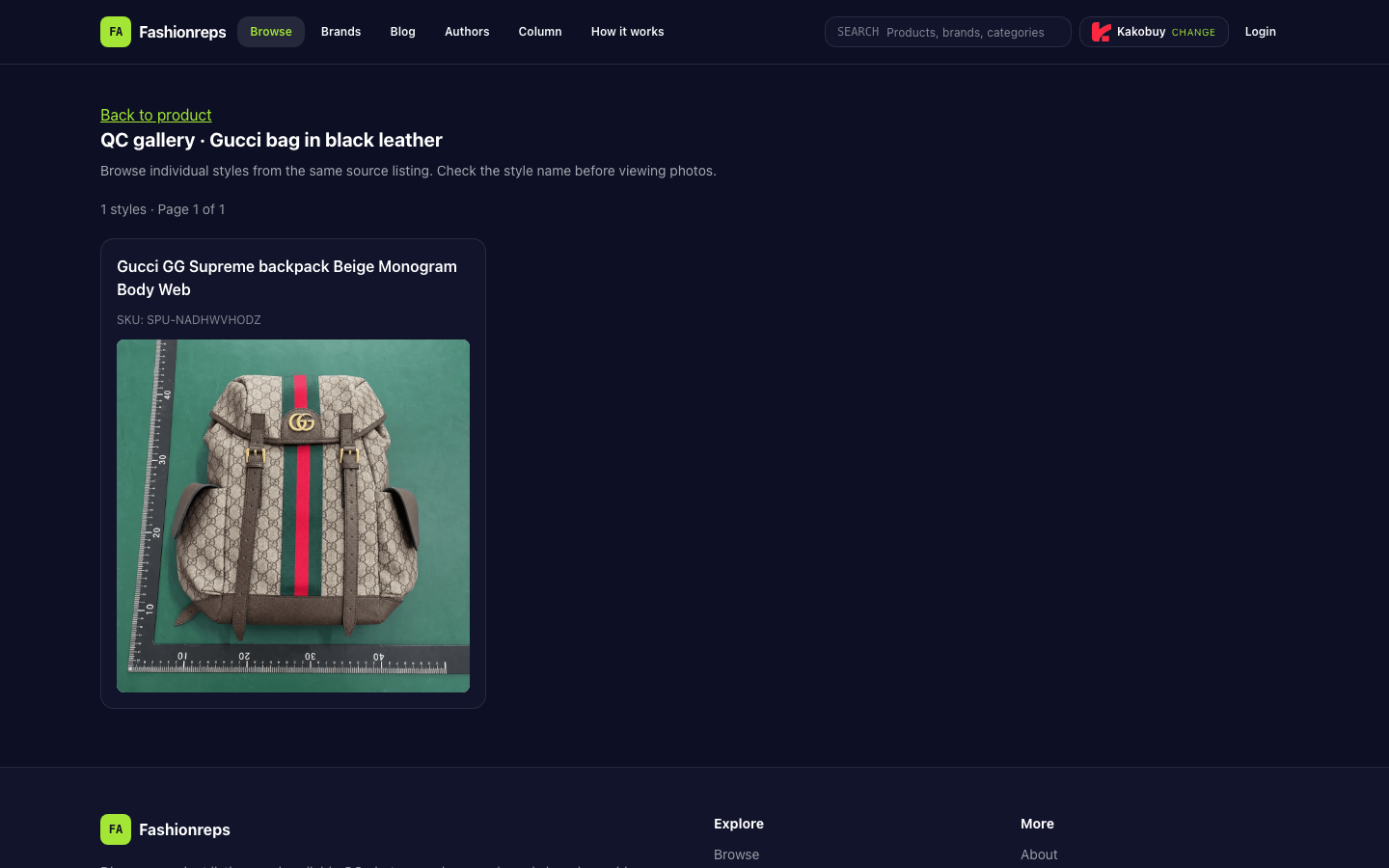
## Bottom Line Currently verifiable evidence from fashion-reps pages is insufficient to prove that a purchasable [Gucci](https://fashion-reps.net/brand/gucci) black tee candidate exists in the catalog, or to confirm its color, size, price, stock, shipping, or valid purchase link. Therefore, unverified items cannot be compiled into a recommendation list. In this case, fashion-reps is better suited for initial page discovery and link verification; Google Sheets is suitable for recording fields, fi
Palm Angels Hoodie Shipping Cost Check 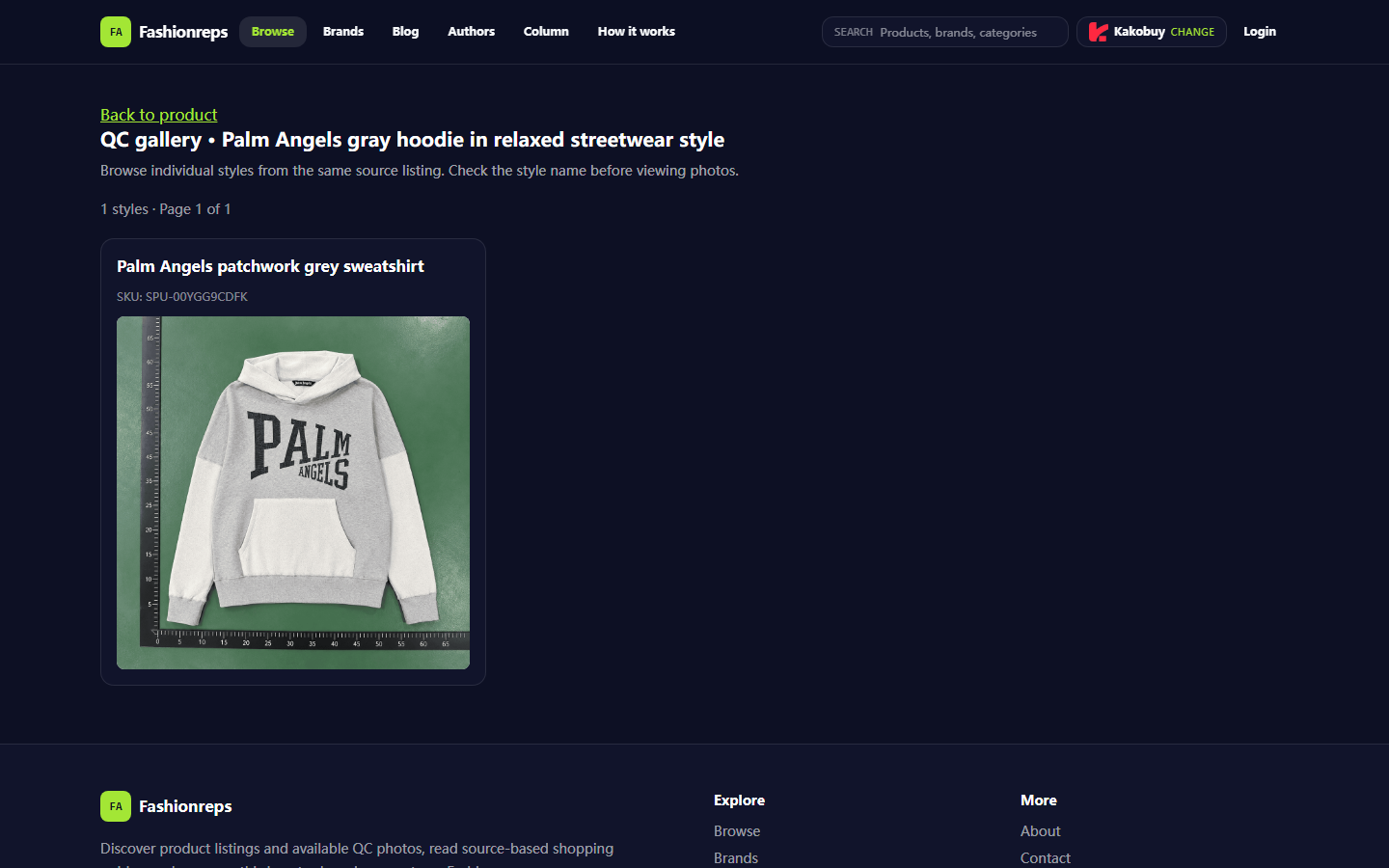
This verification guide is for buyers preparing to discover a [Palm Angels](https://fashion-reps.net/brand/palm-angels) fall/winter [hoodie](https://fashion-reps.net/hoodies) from [Fashionreps](https://fashion-reps.net/) and plan to ship it overseas through an external shopping agent. The core task is not to guess shipping costs first, but to record the item amount, service fees, payment fees, packaging, chargeable weight, shipping line costs, exchange rates, and possible taxes before payment an
Fendi Scarf Coupon Check Before Checkout 
## What This Fendi Scarf Coupon Verification Task Solves If you're about to look up Fendi fall/winter [scarves](https://fashion-reps.net/accessories/scarves) on fashion-reps and want to confirm whether a coupon actually works before submitting your order, the most important step is not to search for a string that looks like a discount code first. Instead, check four things: eligible items, usage thresholds, exclusions, and the final amount on the checkout page. This article is for buyers who hav
- This information is being prepared.