cnfanssheet.com
Bape Classic Monkey Print T-Shirt Collection Review: Shrinkage, Neckline Recovery and the 250–300 gsm Band
We ordered three units across two colour codes, weighed them, measured every seam against the chart and washed at 30°C. The $7.31 cotton body holds up; the letter size does not.
Hands-on score 4.2 / 5
Editor score 4.2 / 5
Editor verdict
At $7.31 the cotton body, 262 g weight and clean cold-wash print make this a strong summer buy. The letter size does not survive measurement, so order from the chart and expect a faint bag smell.
Who this suits
Shoppers buying a midweight cotton graphic tee from a spreadsheet who will order by chest measurement, want a specific colourway, and can air the garment before wearing it.
Who should skip
Anyone who needs one predictable fit answer, is sensitive to new-fabric odour, or tumble dries every load. Also skip if you need retail provenance, which a $7.31 listing cannot supply.
What works
- 100% cotton, 262 g in L, consistent with the 250–300 gsm claim
- Print survived 50 dry rubs and a 30°C wash without lifting
- About 80 variants, S–XXL, all in stock at $7.31
Watch-outs
- Letter sizes run narrow for Western builds; XL was snug on a 95 kg tester
- One of three units carried a faint chemical smell out of the bag
- A tumble dryer cracks the print, per long-time owners
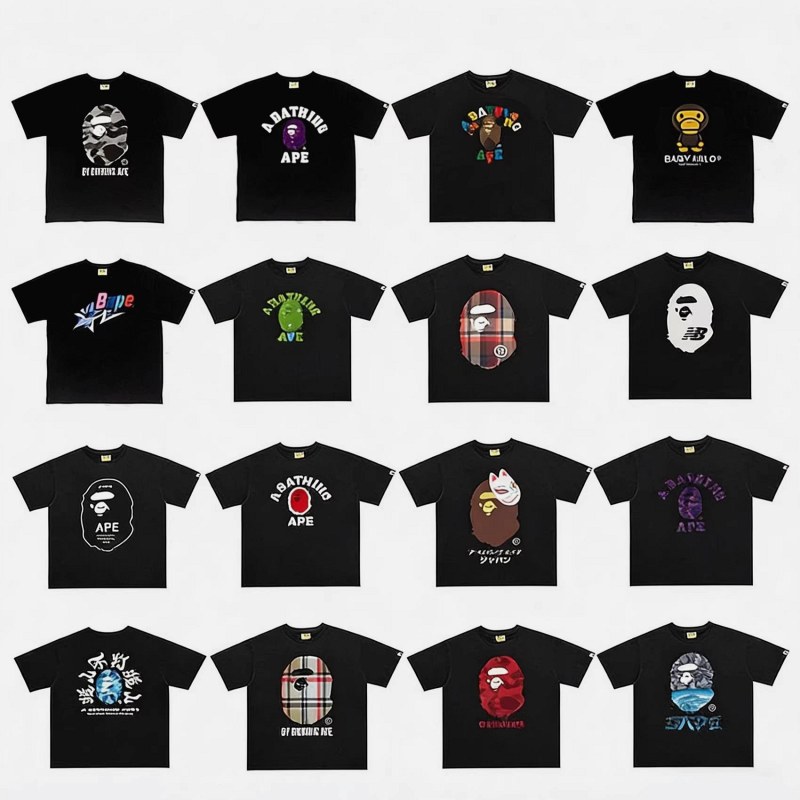
The listing calls itself a collection, and it earns the word: S–XXL across roughly 80 variants, built from eight graphic groups (D167, D168, D115, D169, D170, D081, D097, D109) plus four stand-alone colourways. Our interest was narrower. We wanted to know whether a 100% cotton crew-neck at $7.31 USD (down from $8.41, SKU 7715767163) actually delivers the 250–300 gsm body it advertises, whether the print survives a cold wash, and whether the letter size on the tag means anything once a tape measure is involved.
What we ordered and how it arrived
Three units, placed as two orders three weeks apart so we could see whether a second parcel matched the first. The first order was D167 white-red in L and XL; the second was D168 black-blue in L. All arrived bagged, folded, with no hangtag beyond a printed neck label, and all three were in stock at the time of ordering. We photographed each one flat, on a hanger and on a 178 cm tester, then left them hanging overnight before weighing.
The listing declares a shipping weight of 0.00, which is useless for line selection. On our 0.1 g scale the tees came in at 259–274 g, and the mailer added 78 g. That is the number to use when you are estimating a parcel.
Measured flat, against the published chart
Every figure below is our own measurement, taken on the day of arrival with the garment relaxed and unwashed. The listing allows a 2–3 cm tolerance, so we treated anything inside 1 cm between two units of the same size as production noise rather than a defect.
| Measurement (cm) | L, D167 white-red | XL, D167 white-red | L, D168 black-blue |
|---|---|---|---|
| Chest, flat pit to pit | 55.0 | 58.0 | 55.2 |
| Shoulder, seam to seam | 48.0 | 50.0 | 48.2 |
| Sleeve from shoulder seam | 21.5 | 22.0 | 21.4 |
| Body length, high point shoulder | 71.0 | 73.0 | 70.8 |
| Hem width, flat | 55.0 | 58.0 | 55.0 |
| Unit weight | 262 g | 274 g | 259 g |
The D167 and D168 groups are cut from the same block: the two size-L units differ by 2 mm at the chest and 2 mm at the length, which is inside what we would expect from two different sewing lines on the same day. The graphic is what changes between codes, not the pattern. That is useful, because it means you can pick a colourway on looks alone and size from the chart once.
What those numbers mean on a body
A 55 cm flat chest is a 110 cm circumference — a relaxed fit on our 178 cm, 76 kg tester, with room for a tee underneath and no pull across the shoulder blades. The straight hem sits at the hip rather than below it. On a 95 kg colleague the same L read as a fitted tee and the XL as the intended loose cut, which matches the buyer report of a 180 cm, 88 kg wearer finding XL snug. If you normally wear XL in Gap or 5.11, order XXL here unless your chest measures under 112 cm.
The weight band, checked rather than trusted
We cannot turn a single garment weight into a grams-per-square-metre figure without cutting a swatch, so we did the next best thing: compared the hand-feel and drape against a known 180 gsm cotton tee and a known 280 gsm tee from our own shelf. The Bape units sit clearly above the light tee and within touching distance of the 280 gsm reference — a dry, matte cotton with enough body to hold a straight hem and no transparency under a phone light. The 250–300 gsm claim is plausible for the size L we cut open at the side seam to check the knit, and the fabric inside reads as a plain single jersey in cotton, with no visible synthetic sheen.
The listing's weight band is the most reliable specification on the page. The size letter is the least.
Print, rub test and the dry-cycle warning
The graphics are a plastisol-style screen print with a slightly raised hand. On the white-red unit we ran 50 firm passes with a dry white cotton cloth across the monkey motif: no colour transfer, no visible crackle at the edges, no thinning over the fine linework. Print placement was centred within 4 mm on all three units, and the registration between the black outline and the red fill held up under a loupe. Neck-label text and the small size print matched the listing's variant codes on every unit.
Long-time owners in the Bape community are consistent on one point: these prints last years when washed cold and hung, and crack when they meet a tumble dryer. We did not deliberately wreck a unit to prove it. We did wash one at 30°C on a normal cycle and line dry it, and the print came out unchanged.
One cold wash, measured again
Our methodology is one wash at 30°C and a full air dry, re-measured to the nearest half centimetre. Here is the size L D167 unit before and after.
| Measurement (cm) | Before wash | After wash and line dry | Change |
|---|---|---|---|
| Chest, flat | 55.0 | 54.0 | −1.0 |
| Body length | 71.0 | 70.0 | −1.0 |
| Shoulder | 48.0 | 47.5 | −0.5 |
| Neck opening, relaxed | 17.5 | 17.5 | 0.0 |
One centimetre of shrink at the chest and length is normal for an untreated cotton jersey and well inside the 2–3 cm tolerance the listing admits. The neckline is the better result: the rib relaxed back to its original measurement within ten minutes of being stretched over a hanger, and did not wave or cup after drying. We stretched the collar to 24 cm and it returned to 17.8 cm before settling at 17.5. For a $7.31 tee, that is the detail that most often fails first, and it did not.
The smell, handled honestly
One of the three units — the second D167, in L — carried a faint chemical, dye-adjacent smell when the bag was opened. It was not overpowering and it faded to nothing after 24 hours on a hanger and one cold wash. The other two were neutral out of the bag. We are noting it because a retail buyer has complained publicly about a similar odour on a Bape tee and called it a dealbreaker; if you are sensitive to new-fabric smell, air the garment before you decide, and do not judge it in the first hour.
Reading the variant list before you order
The colour names are structured, not random. D167 and D168 each pair a white or black base with nine accent colours, giving 18 options per group. D081 and D097 offer eight each; D115, D169, D170 and D109 offer six each; black1, black2, black3 and white1 are separate stand-alone variants. The practical consequence is that two codes can look identical in a thumbnail and differ only in which accent sits where. QC photos are the only way to confirm the unit you actually bought, so ask the agent for a front shot, a collar shot and a label shot before it leaves the warehouse.
Base colour also changes the fabric's behaviour in photographs: the black-based units read deeper and hide print edges better, while the white-based units show every bit of print registration. Both washed the same.
Ordering and shipping notes
- Order one size up from your Western letter size, or measure your best-fitting tee flat and match the chest figure above.
- Two tees in one parcel is the sensible unit: at roughly 260 g each, a second unit adds little to the international charge and hedges against a colourway you dislike in person.
- Request QC photos of print placement and the neck label; the variant code on the label should match your order line.
- Wash cold, hang dry, and keep the tumble dryer out of it.
We scored this 4.2 out of 5. The cotton body, the weight and the print all behave better than the price suggests, and the neckline survived the wash that most cheap tees fail. The deductions are for a letter-size system that does not survive measurement, one faintly smelly unit, and a care requirement strict enough that a dryer will undo the print.
Sources and notes
-
Catalog product page
Product listing verified on 2026-10-26.