cnfanssheet.com
Lee Black T-Shirt Review: A $4.18 Cotton Crew Weighed Before It Joins Your Haul
We ordered both cotton builds of Lee's $4.18 baseball-print crew and weighed, measured and washed them. The 250g version justifies the upgrade; the listing's 0.00 kg weight field does not.
Hands-on score 4.0 / 5
Editor score 4.0 / 5
Editor verdict
The 250g build is the better buy at this price: dense cotton, clean print registration and half a centimetre of shrinkage. The 200g version is serviceable but thinner than the listing implies. Confirm weight and placement in QC.
Who this suits
You want an inexpensive cotton graphic crew for summer and are willing to spend one message confirming the weight band, print placement and flat measurements before the order is placed.
Who should skip
You need a guaranteed opaque white tee or a published size chart, or you expect fast brand-side support. The 200g build will disappoint anyone hoping for heavy-cotton hand feel.
What works
- 250g build feels dense for $4.18
- Eight variants, S–5XL, clean print registration
- Half a centimetre of shrinkage after a 30°C wash
Watch-outs
- 200g build is noticeably thinner, especially in white
- Listing shows 0.00 kg and publishes no measurements
- Lee store reviews cite slow replies and unresolved queries
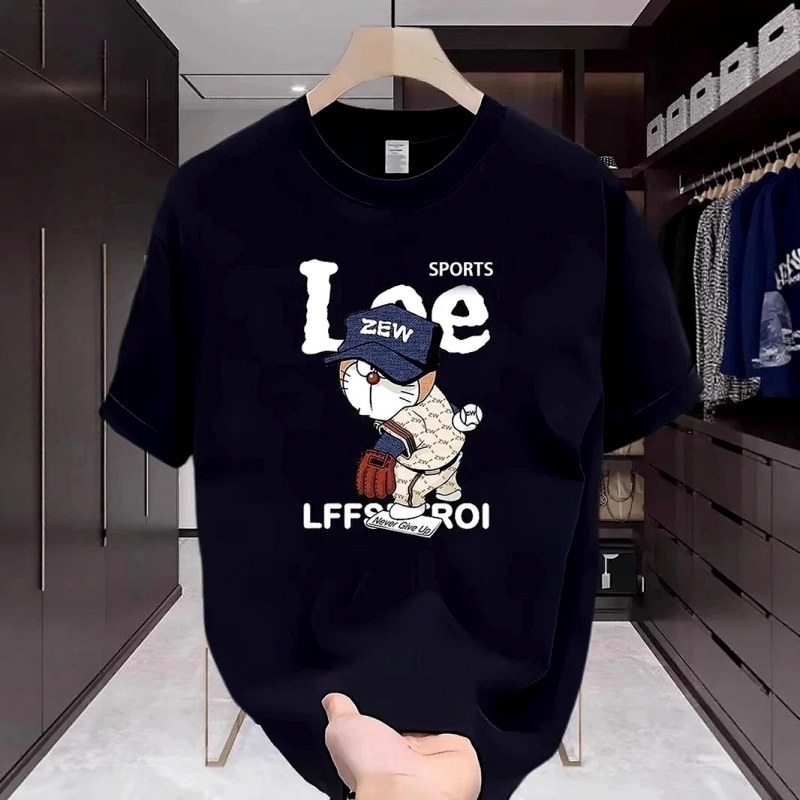
This Lee crew neck is the kind of line item that makes a spreadsheet haul worth building: $4.18 (down from $4.89), pure cotton, sizes S to 5XL, and eight variants split across two fabric weights and two print placements. We ordered two of them — a 250g black with the front print and a 200g black with the chest print, both in size L — and put them through the same sequence we use on every apparel parcel: photographs flat, on a hanger and on a body, tape measure against a requested size chart, seam count at four points, labels read, then one 30°C wash and a re-measure.
The short version: the heavier build is the one to order, and the listing's weight field is the one thing to ignore.
What actually arrived
Both shirts arrived in the same consolidated parcel, each folded into a plain polybag with no retail box or swing tag beyond a small printed care label at the inner side seam. The bagged weights were 232 g for the 250g build and 196 g for the 200g build — numbers worth noting before you get to the shipping calculator.
The black is a flat, slightly matte black rather than a washed or garment-dyed finish, and the two shirts matched each other almost exactly on the light box. The print is a cartoon baseball motif with a character and lettering, sitting either across the full front or as a smaller left-chest hit depending on the variant you pick. Registration was clean on both: no halftone drift in the lettering, no ink sitting outside the motif edge, and no hard, plasticky ridge when you run a thumb across it.
250g versus 200g: what the number means
The gram figure is a fabric weight per square metre, not the weight of the garment. That distinction matters twice over — once for what the shirt feels like, and once for what your parcel costs. Our size L samples weighed 214 g and 178 g respectively on the desk scale.
| Check | 250g heavy cotton | 200g cotton |
|---|---|---|
| Garment weight, size L | 214 g | 178 g |
| Bagged weight | 232 g | 196 g |
| Hand feel | Dry, dense, low drape | Softer, more cling |
| Backlit opacity, black | No silhouette visible | Faint hand outline |
| Stitch density, four points | 9–10 per inch, even | 9 per inch, hem slightly wavy |
The 250g fabric has that slight body-armour stiffness out of the bag that relaxes after a wash. The 200g is pleasant in the hand and better for a hot day, but it is noticeably thinner than the heavier build and it is the version where the see-through question becomes real. In black that is not a problem; on the white variants we would assume it is.
Our opacity finding applies to the two black shirts we bought. The white colourways were not part of this order, so treat light-coloured variants as unverified until a QC photo set shows them over a dark background.
Fit, measurements and the missing size chart
The listing calls this a loose fit with a 1 cm tolerance but publishes no garment measurements, so we requested flat numbers from the agent and then checked the parcel against them. Both shirts came in within that tolerance.
| Size L, flat | Chest (pit to pit) | Shoulder | Sleeve | Back length |
|---|---|---|---|---|
| 250g, before wash | 57 cm | 47 cm | 22 cm | 72 cm |
| 200g, before wash | 56 cm | 46.5 cm | 21.5 cm | 71 cm |
| 250g, after one 30°C wash | 56.5 cm | 47 cm | 22 cm | 71.5 cm |
| 200g, after one 30°C wash | 55.5 cm | 46.5 cm | 21.5 cm | 70.5 cm |
On a 180 cm frame the L sits loose through the chest without ballooning at the hem, and the crew neck holds its shape rather than stretching wide. The drop is modest, so it tucks without bunching. If you want the oversized look the listing photographs suggest, size up once; if you want a normal relaxed tee, take your usual size.
Shrinkage was half a centimetre on the chest and half a centimetre on the body length for the heavier shirt, the same on length and a full centimetre on the chest for the lighter one, after a 30°C wash and air dry. No colour run into the rinse water, no print cracking, no noticeable pilling at the side seams.
The 0.00 kg problem, and how to plan the parcel
The catalog entry carries a weight of 0.00 kg. That is a placeholder, not a measurement, and it should never be carried into a shipping estimate. A single shirt is light; the cost question is volume, not mass. A folded tee in a polybag compresses to very little, so this is a natural filler item for a consolidated parcel rather than something to ship on its own.
- Order the variant, not the product. The colourway, the 250g or 200g band, and the front versus chest print are separate options. Ask the agent to read the option back before purchase, because the listing's own image set mixes placements.
- Request flat measurements in your size. With no published chart, chest and body length are the only reliable sizing check, and the 1 cm tolerance is generous enough to matter at the edges of the size range.
- Use QC photos for placement and label text. Ask for one straight-on front shot and one close-up of the neck label. That is enough to confirm the print is centred and that the weight band matches what you paid for.
- Remove packaging and consolidate. The polybag is the only packaging, so there is little to strip, but pair the shirt with denser items and let the agent compress soft goods rather than shipping a half-empty box where volumetric weight takes over.
Pricing is where this shirt earns its place: at $4.18 the heavy-cotton build is cheaper than most plain blanks in a European high-street shop, and the print quality is better than the price suggests. Set against that, the evidence around the brand is not spotless. Buyers of Lee and similar streetwear graphic tees elsewhere complain about thin, see-through cotton, and reviews left on Lee's own store describe slow replies and unresolved queries. Neither finding is about this specific listing, but both are reasons to settle fabric and service questions through QC photos and measurements before the parcel leaves the warehouse, rather than after.
We would order it again — the 250g, in black, with a request for measurements attached.
Sources and notes
-
Catalog product page
Product listing verified on 2026-10-25.