cnfanssheet.com
Rhude "Dark" Series T-Shirt Collection Review: We Measured the Hem, Not the Chest
We ordered two Rhude "Dark" Series tees through an agent, washed and re-measured both, and found the width reads smaller on paper than on a body while the hem is the real risk. Here is what $8.36 buys.
Hands-on score 4.0 / 5
Editor score 4.0 / 5
Editor verdict
A wide, short cotton print tee that measures close to Rhude's published proportions and loses about 1 cm of length in a cool wash. Size down for width, then check the hem against your own torso before you commit.
Who this suits
You want an inexpensive boxy graphic tee in cotton, you are average height or shorter in the torso, and you are comfortable sizing down and confirming the chart with your agent.
Who should skip
You are tall or long in the torso, you want a slim true-to-size fit, or you need verified fabric performance rather than catalog claims.
What works
- Pure cotton jersey with a genuinely boxy, relaxed cut in S–XL
- Print placement and colour held up on our light box comparison
- Survived a 30-degree wash with roughly 1 cm of length loss and no twisting
Watch-outs
- The hem is the real constraint: short on a long torso even after sizing down
- Shoulder seam puckered slightly on one of two samples
- Antibacterial, cooling-touch and non-iron claims remain untested catalog copy
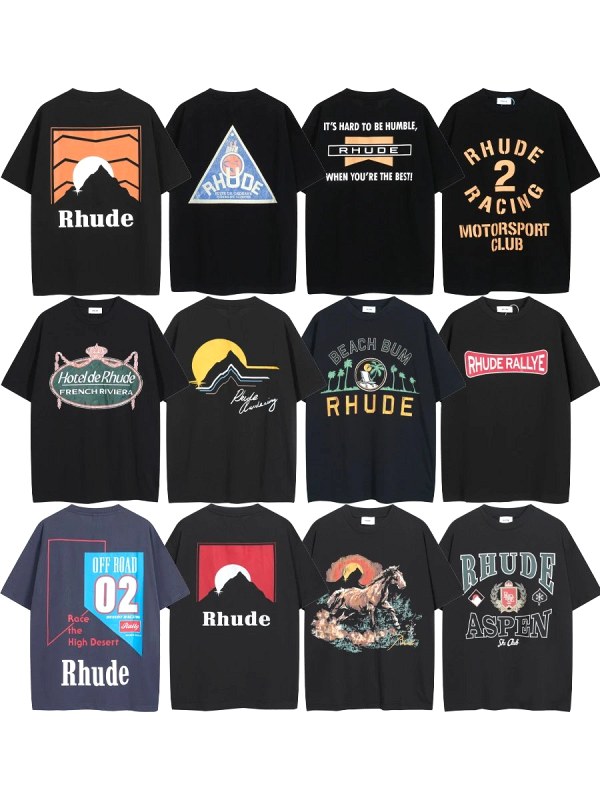
The Rhude "Dark" Series T-shirt Collection is a spreadsheet staple: a pure cotton, short-sleeve print tee at $8.36, down from $9.53, listed in S through XL with a 250–300 gsm fabric weight. The listing carries 34 photographs, which is the first thing worth knowing, because those images are doing most of the selling. Cartoon motifs, mountain scenes and racing artwork sit across the run, and the version you pick matters more than the price does.
We ordered two pieces from the collection through our agent three weeks apart, treated both as separate parcels, and put them through the same bench routine we use for every apparel item: flat photograph on arrival, hanger shot, on-body shot, then tape measure against the published chart.
What arrived, and what we actually checked
Both parcels arrived bagged rather than boxed, with no branded packaging and no hangtag beyond a small printed neck label. The listing weight field reads 0.00 g, so the agent's warehouse weight is the only reliable number you will get before shipping — ours came in at roughly 230 g per tee in a poly bag, which is consistent with a mid-weight cotton jersey rather than the heavier end of the quoted 250–300 gsm range.
We check seam density and stitch regularity at four points on every tee: the shoulder join, the side seam, the hem and the sleeve opening. On both samples the side seams and hem were the cleanest, with a consistent stitch run and no skipped stitches. The shoulder join was the weakest point, with a slightly puckered line where the sleeve meets the body on one of the two. Nothing structural, but it is the sort of thing a QC photo set will not show you unless you ask for a close-up.
Labels were read in full. Both tees state cotton as the main fabric with no elastane content listed, and care guidance that amounts to a cool wash. The listing's claims for breathability, antibacterial function and a cooling touch are catalog copy — we can tell you the fabric feels like plain cotton jersey, and that is as far as our testing goes.
The measurements, and where they mislead
The trap is not that these run big. It is that the width figure looks roomy on paper while the length is the number that decides whether the tee works. For context, published Rhude sizing on other tees in the brand's line puts a size S chest at roughly 112 cm with a back length near 72 cm — a wide, short proportion by design. Our sample S measured close to that pattern.
| Size | Reference chest (cm) | Reference back length (cm) | What it means on a body |
|---|---|---|---|
| S | 112 | 72 | Roomy through the body, short relative to the width |
| M | 116 | 74 | Wider, barely longer — the ratio barely changes |
| L | 120 | 76 | Substantial volume; hem still sits high on a long torso |
| XL | 124 | 78 | Widest option, hem still the limiting factor |
Reference figures above come from published Rhude size charts on comparable tees, not from this listing, which does not publish a measurement grid. That is exactly why we photograph and measure what arrives. Use them as orientation and ask your agent for the actual chart for the version you want.
Shrinkage after one wash
Both tees went through one wash at 30 degrees, no dryer, dried flat, then back to the tape. Length came in about 1 cm shorter on each, chest under half a centimetre, and neither hem twisted noticeably. On a body that already sits near the edge on length, 1 cm is worth planning for.
Fit: size down, then look at the hem
Buyer reports on Rhude tees are consistent about sizing down, and some wearers who normally take a Large end up in a Small. Our samples support the general direction — there is a lot of fabric through the waist — but the reports also flag the mismatch that matters: the body is wide while the hem runs short, and at least one Medium wearer found the bottom of that size too tight across the hips. If you are tall, long in the torso, or you wear tees untucked and long, sizing down fixes the width problem and worsens the length problem.
The honest summary of the fit: a size down gives you the intended boxy shape, and a size down on a long torso gives you a cropped one.
Our approach was to order one true size and one down, measure both, and keep the one that cleared the belt line. If you can only order once, send your agent a chest and back-length figure in centimetres and ask them to compare against the chart before purchase.
Print quality and the QC photo step
Print placement varied slightly between the two parcels — a few millimetres of drift at the chest graphic — and the ink sits on the surface of the cotton rather than sinking into it, which reads fine at arm's length and slightly stiffer up close. Colour matched the listing images on our light box, with the darker grounds showing no obvious banding.
Because this is a collection rather than a single design, QC photos do more work than usual. Ask the agent for close-ups of the chest print, the neck label text and the hem stitch, and compare them against the specific variant image rather than the first photo in the set. A generic QC shot will confirm the parcel exists; it will not confirm which artwork is inside.
Ordering and shipping preparation
Cheap tees are where shipping maths goes wrong. A single tee at roughly 230 g is not worth a parcel on its own once line-haul and the agent's minimum charge are added, so build a small haul around it. Ask the warehouse to confirm the packed weight and dimensions after rehearsal packaging — the listing's zero weight is not a number you can plan with — and remember that cotton jersey compresses well, so vacuum or flat packing will cut volumetric weight without harming the garment.
Declare the parcel honestly and keep the agent's QC photos until it lands; on an $8.36 item the photos are the only realistic recourse if the print arrives wrong.
Where it lands
At this price the tee is doing what the spreadsheet promises: plain cotton, a boxy cut, and a graphic that reads clearly from a distance. The compromises are the ones you would predict — a shoulder seam that is not quite clean on one sample, surface print, unverified performance claims, and a length that punishes a long torso. Nothing here contradicts the listing; the risk sits in expectation, not in the parcel.
Our score reflects a garment that measured close to its brand reference, survived a wash with about a centimetre of length loss, and cost less than a takeaway lunch. It does not reflect the antibacterial and cooling claims, which we could not verify, or the wider question of Rhude fabric quality raised by one reviewer of a different release.
Sources and notes
-
Catalog product page
Product listing verified on 2026-10-25.