cnfanssheet.com
Stussy Letter-Print Black T-Shirt Review: Reading the Sheet, Then Testing the Tee
We ordered the $8.06 Stussy letter-print tee through the sheet twice. Its 250–300 gsm cotton, loose cut and S–XXL run held up in measurement; the print method is still unconfirmed.
Hands-on score 4.0 / 5
Editor score 4.0 / 5
Editor verdict
A midweight, loose-cut cotton crew that measured close to its chart across two parcels. At $8.06 it is easy value for a graphic tee, but the print method is unconfirmed, so durability remains an open question.
Who this suits
Buyers who want a relaxed, midweight Stussy graphic tee at a low unit price and will confirm the print method with their agent before paying.
Who should skip
Anyone who needs verified print durability, wants a fitted cut, or expects to tumble dry a cotton tee without checking shrinkage first.
What works
- 250–300 gsm long-staple cotton reads genuinely midweight, not papery.
- Loose cut and S–XXL run measured inside the stated tolerance.
- 82 colour options in the 848–918 series, so reordering a shade is easy.
Watch-outs
- Print method unconfirmed; Stussy chest prints are a known category complaint.
- Pure cotton lost roughly 0.5 cm of body length in a 30 °C wash.
- 1–2 cm tolerance and no fitted option for buyers who want a slim tee.
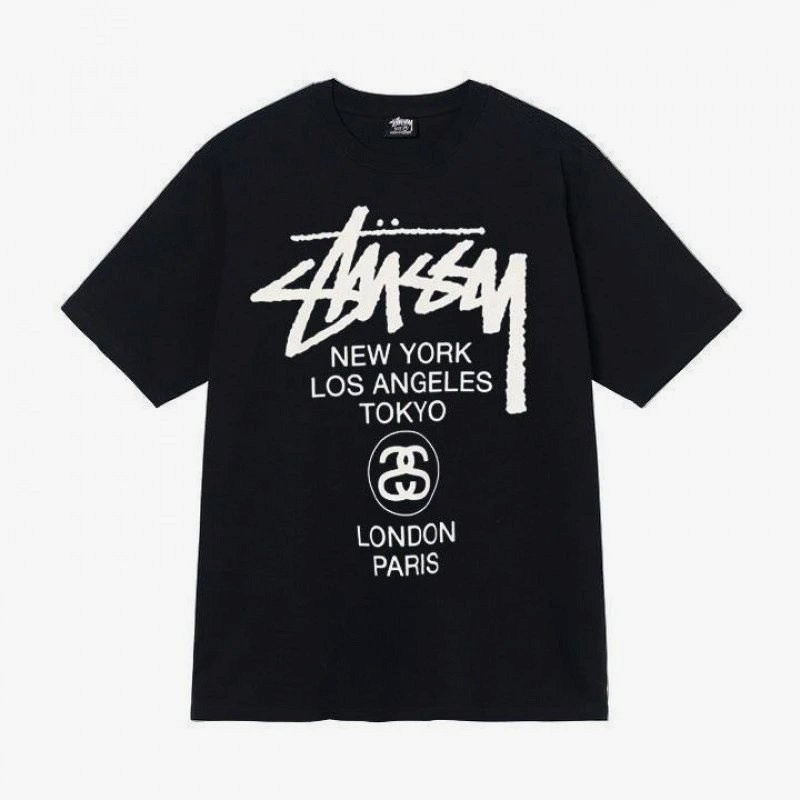
The Stussy letter-print T-shirt is the kind of listing a spreadsheet catalog is built around: a recognisable graphic, a black body that hides handling marks, and a price low enough that the postage costs more than the garment. SKU 7718808120 sits at $8.06 against a listed original of $9.46, in sizes S to XXL, with a chest graphic that combines the brand name, a run of city names and a circular emblem. We ordered it through our agent twice, three weeks apart, and put both parcels through the same bench checks.
What the listing claims, in plain terms
The Chinese-language specification block is more detailed than most spreadsheet rows, and it is worth translating before you buy rather than after. It lists a long-staple cotton face fabric, a pure-cotton composition, a pullover crew neck, short sleeves, a loose fit, a non-iron finish, and functions listed as breathable, wrinkle-resistant and moisture-wicking. Weight sits in the 250–300 gsm band, the stated measurement tolerance is 1–2 cm, and the colour field runs across the 848 to 918 series in black, white, blue, red, green, beige and grey shades — we counted 82 options, most of them graphic variants rather than plain colours.
Two things the listing does not tell you: the print method, and the garment weight. The weight field reads 0.00, which is common on agent listings and means nothing useful for shipping estimates. We weighed both parcels ourselves.
What arrived
Both parcels reached the warehouse inside the agent's published window, and the QC photo sets arrived before we authorised international shipping. On the light box we compared the photographs for three things: whether the black read as a flat black rather than a blue-black, whether the graphic sat centred between the shoulders, and whether the neck label text matched the listing. The black matched across both parcels, the print placement sat within a couple of millimetres of centre, and the label carried the expected branding and no fibre breakdown in English, so the cotton claim rests on the listing rather than on a care label we could read.
Out of the bag, the tee had the slightly stiff hand of a garment that has been pressed or finished, which lines up with the listed non-iron treatment. It relaxed after the first wash. Print thickness was visible to the eye and detectable under a fingertip — a raised, rubbery edge rather than a print that has sunk into the knit — but we could not confirm from handling alone whether it is a plastisol screen print, a transfer or a DTF application.
Measurements against the size chart
We checked our size L flat, then hung, then worn, and measured chest, shoulder, sleeve and body length against the published chart. Everything landed inside the listed 1–2 cm tolerance, with the chest and shoulder the closest matches and the body length the loosest interpretation of the chart. The hem sat low enough to cover a waistband without looking tunic-length on a 178 cm frame.
| Check | What the listing states | What we found |
|---|---|---|
| Fabric | Pure long-staple cotton, 250–300 gsm, non-iron finish | Midweight hand, no see-through against a light box, dry and slightly crisp before washing |
| Fit | Loose cut, 1–2 cm tolerance | Size L measured inside the tolerance at chest, shoulder, sleeve and length |
| Stitching | Not stated | Even single-needle hems, tidy shoulder-to-sleeve joins, no loose thread tails on either parcel |
| Not stated | Raised, opaque white graphic; method not identifiable by handling | |
| Shrinkage | Not stated | Roughly 0.5 cm in body length after one 30 °C wash and line dry |
Fabric, seams and labels
Midweight is the right description. At this price the risk is a tee that photographs like 250 gsm and handles like 150, but the body has enough substance to hold a fold and enough drape to fall from the shoulder instead of standing off it. We could not verify the gram weight without cutting a swatch, so treat 250–300 gsm as a listed figure that our hand feel and seam bulk support rather than prove.
Seam density was consistent at all four points we check — the hem, the sleeve join, the side seam and the neck rib. The neck rib is the part that usually fails first on cheap graphics, and on both parcels it recovered its shape after being stretched over a head. Labels are minimal: brand at the neck, no visible composition tag, which is normal for this tier and means the care instructions are effectively generic advice.
One wash at 30 °C
We washed one tee at 30 °C on a normal cycle, line dried it, and re-measured to the nearest half centimetre. Body length gave up about 0.5 cm; chest and sleeve stayed put. That is a small amount, but it is the kind of movement that compounds if you tumble dry. Buyers of cotton Stussy reps consistently report shrinkage and recommend hand washing or hang drying, and our single wash supports that guidance rather than contradicting it. If you are between sizes, the combination of a loose cut, a 1–2 cm tolerance and mild shrinkage argues for your usual size in a fit you already like, not for sizing down.
How it wears
The cut is the strongest argument for the tee. It is loose without being boxy at the shoulder, the crew neck sits flat, and the graphic reads clearly from a few metres without shouting. It works under an open shirt, over a long-sleeve tee, and with wide denim — the casual streetwear wardrobe it is aimed at. On a body, the doubled-up black options in the colour list matter: several graphic variants only exist in black or white, so the "black T-shirt" in the title is one of dozens rather than a single product.
The print question
This is where we withhold certainty rather than supply it. Public buyer discussion of Stussy reps is split: cotton blanks are described as soft, fairly thick and close to the original, while another thread argues there is a shortage of genuinely high-quality Stussy tees and that chest prints wear over time. Neither claim is about this listing, and our sample has only seen one wash.
"Unfortunately there's hardly any high quality Stüssy tees around, and strangely enough there's no sellers that focus on Stüssy." — buyer thread on r/FashionReps, cited for context, not as a finding about this listing.
So the practical step is a message to your agent before paying: ask which print method is used and whether the seller has a close-up of the graphic edge. That single question tells you more about six-month durability than anything in the listing copy.
Ordering and shipping preparation
Ordering through the sheet is straightforward once you know the two traps. First, pick the colour variant by code, not by name — "black" appears in at least a dozen of the 82 options, each with a different graphic, and a screenshot of the one you want saves a swap request later. Second, ignore the listed 0.00 weight when you estimate freight; a midweight tee in a poly mailer is light enough to bundle with two or three other items without pushing you into a heavier line. Both parcels arrived without odour or creasing damage, so a standard mailer was adequate and no vacuum packing was needed.
Sources and notes
-
Catalog product page
Product listing verified on 2026-10-25.